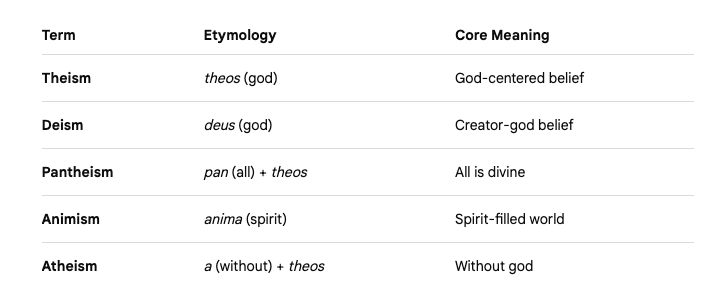
We have a word for those who stand outside of faith: atheist. It is a familiar label, defined by a simple binary—you believe, or you do not. But there is a forgotten middle ground found in the word deist. When that term faded from our collective lexicon, pantheism collapsed into this same rigid binary, and our understanding of the sacred was flattened.
Theism is a monopoly on the hypothetical
Theism is a monopoly on the hypothetical. A theurgic fascism. Historically, theism was never just a vague “belief in God.” It was a commitment to a singular, patriarchal center of authority—a galactic navel of “THE-ness” around which the universe rotates. In this framework, theism is the belief in an objective hypothetical.
When someone says, “the chair,” they presuppose a chair existing outside of the one they are beholding. This specificity is Platonism hiding in plain sight. Theism allows us to instantiate a chair from an eternal library more perfect than our own. Our physical chair is merely the closest example. In this framework, the physical chair becomes a sin against the Platonic perfection.
Theism and Platonism posit a world where sacredness is not inherent, but must be funneled through an interface. The Trinity, for instance, functions as a rational attempt to explain how a hypothetical deity penetrates a profane physical realm. This view requires the material world to be “not-God,” effectively denigrating matter to venerate a distant, hypothetical plane. If God is the definition of good, then the physical world—by virtue of being separate—becomes a vacuum of good, a damnation we inhabit simply because the definition of a transcendent god demands it.
When modern atheists reject “God,” they are often not rejecting the sacred itself; they are rejecting this specific, monopolistic structure.
The Percolating Divine
Deism was a different cosmology. For a deist, the divine percolates. A deist doesn’t start with a profane world; they start with a world that is inherently sacred.
Theism: The world is profane. God’s grace makes it sacred.
Deism: The world is sacred. Man’s disgrace makes it profane.
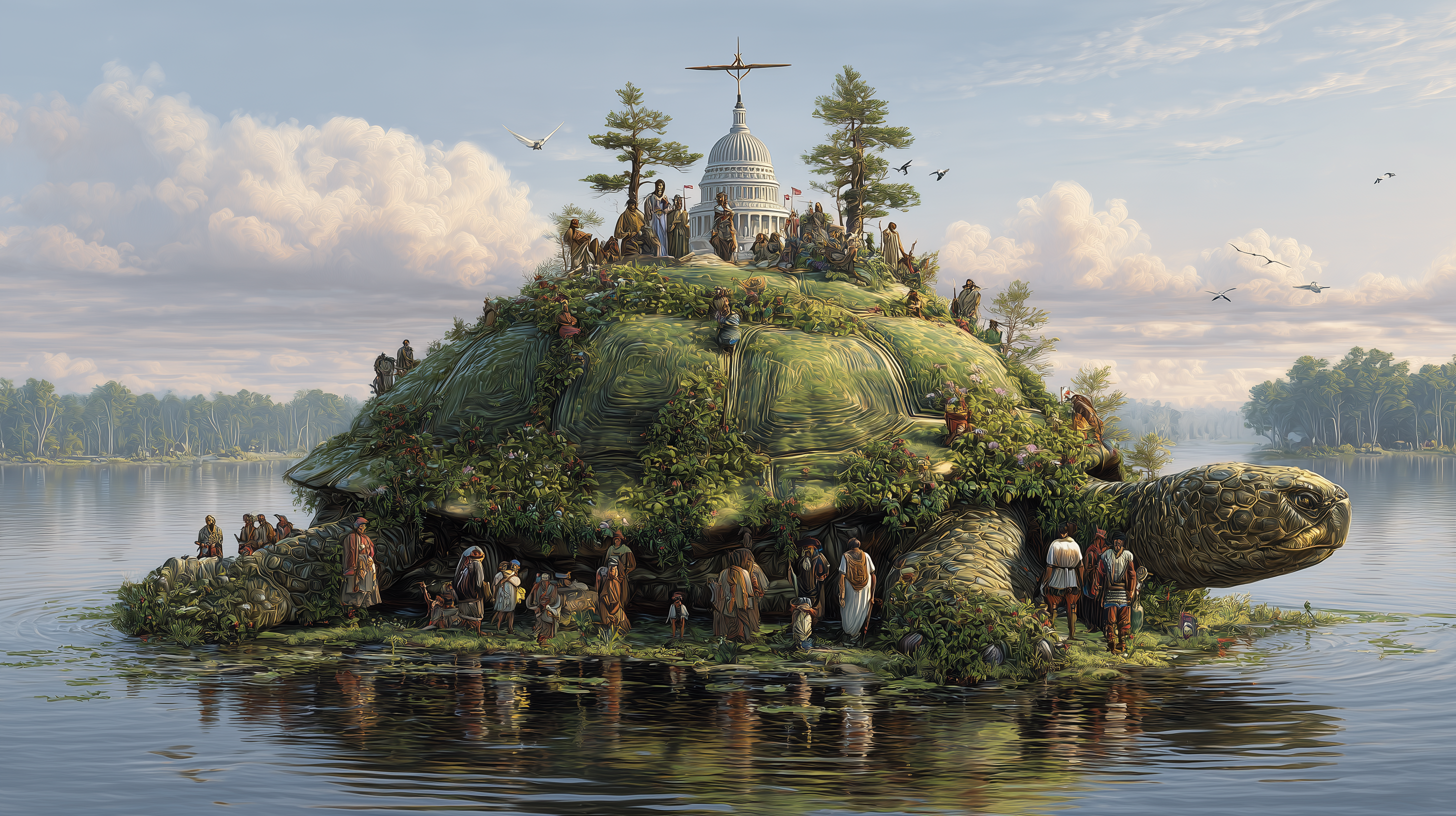
The Haunting of Turtle Island
This deistic psychology was the bedrock of American philosophy. The Founding Fathers were not traditional theists; they worshipped in the “church of reason” and direct experience. This gave birth to the naturalism of William James, the transcendentalism of Thoreau, and the sprawling humanism of Whitman.
The Age of Enlightenment grew on the hills of Turtle Island. Early America encountered a “poly-confederacy” of nations in settlements as vast as London, thriving without a monarchy or federal authority. Early America was a natural congress ruled by natural law. It taught the principles of liberty in a living college with living consequences.
American deism is an organic technology hiding in the canopy. It is American paganism. It is Nahuatl. It is Algonquin. It is Choctaw. It is Jeffersonian.